
Different Types of Research: Methods, Approaches and Their Uses
Different Types of Research
Research is a systematic way of asking questions, gathering information and developing a better understanding of a subject. It is used across fields including health, education, science, business and the social sciences. The right approach depends on the question being asked, the information available and the purpose of the study.
Research can be classified in several ways. These categories often overlap: a single study might, for example, be applied, mixed-methods and longitudinal.
Basic and applied research
Basic research
Basic research aims to expand knowledge and understanding, rather than solve an immediate practical problem. It may explore how a process works or test a theory. Its findings can provide a foundation for later studies and practical developments.
Applied research
Applied research addresses a specific real-world issue. It may investigate how to improve a service, evaluate a policy or identify ways to prevent a particular problem. The aim is to produce findings that can inform decisions or action.
Quantitative, qualitative and mixed-methods research
Quantitative research
Quantitative research gathers and analyses numerical information. Researchers may use surveys, measurements, experiments or existing datasets to identify patterns and compare results. It is often useful when a study needs to measure how common something is or assess whether two factors are associated.
Qualitative research
Qualitative research explores experiences, views and meanings in depth. Common methods include interviews, focus groups and observations. Rather than relying mainly on numbers, it examines how people understand an issue and the context in which it occurs.
Mixed-methods research
Mixed-methods research combines quantitative and qualitative approaches. For instance, a survey may show how many people experienced a particular issue, while interviews help explain those experiences. Using both forms of evidence can provide a fuller picture, although it requires careful planning and analysis.
Exploratory, descriptive and explanatory research
Exploratory research
Exploratory research is used when a topic is not yet well understood. It helps researchers identify important questions, clarify concepts and develop ideas for further investigation. It is often an early step in a larger research project.
Descriptive research
Descriptive research sets out what is happening, or what a group, situation or phenomenon is like. It can describe characteristics, behaviours or trends, without necessarily explaining why they occur.
Explanatory research
Explanatory research investigates why or how something happens. It may test a theory or examine possible relationships between factors. Researchers need to consider alternative explanations before drawing conclusions.
Experimental and observational research
Experimental research
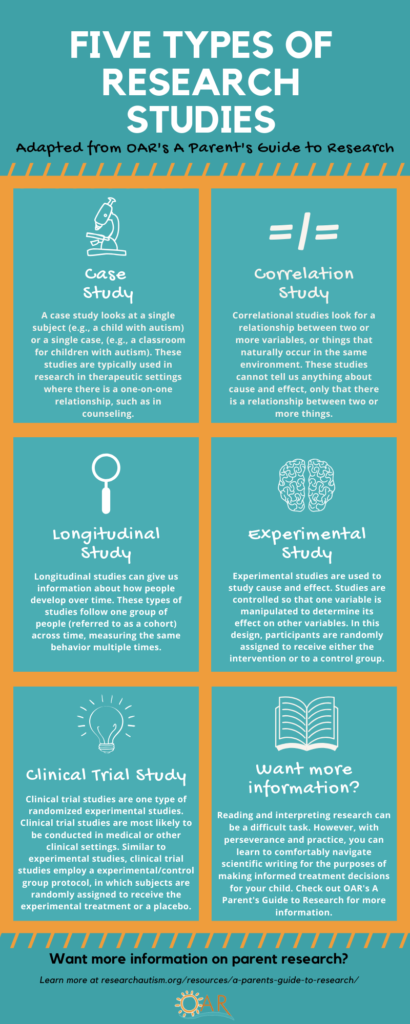
In experimental research, the researcher deliberately changes one or more conditions and observes the results. Where possible, participants are assigned to different groups, such as a treatment group and a comparison group. Well-designed experiments can help establish whether an intervention caused an observed effect.
Observational research
In observational research, researchers study what happens without deliberately changing the conditions. This can be useful when an experiment would be impractical or unethical. Observational findings can reveal patterns and associations, but they do not always show that one factor caused another.
Primary and secondary research
Primary research
Primary research involves collecting new information for a particular study. This may include conducting interviews, carrying out experiments or distributing questionnaires. The researcher can tailor the data collection to the research question, but gathering new data can take time and resources.
Secondary research
Secondary research uses information that has already been collected or published, such as academic studies, official statistics, reports or historical records. Reviewing existing evidence can reveal what is already known and where further research may be needed. Researchers should assess the quality, relevance and limitations of their sources.
Cross-sectional and longitudinal research
Cross-sectional research
Cross-sectional research collects information at a particular point in time. It can provide a snapshot of a population or issue, but may not show how circumstances change over time.
Longitudinal research
Longitudinal research follows the same people, groups or issues over an extended period. It can help researchers understand change and the order in which events occur. However, it usually requires more time and may be affected by participants dropping out.
Action research
Action research is carried out to improve a practice or situation, often in a workplace, school or community. Researchers and participants work together to identify a problem, try an intervention, review what happened and decide what to do next. This cycle of action and reflection can make findings directly relevant to the people involved.
Choosing a research approach
There is no single best type of research. The approach should match the research question, the setting and the evidence needed. Researchers also consider practical matters such as time, resources, access to participants and ethical responsibilities. A clear question and a suitable method help ensure that findings are useful, trustworthy and interpreted with care.
6 Tips for Choosing the Right Research Method
- Use interviews or focus groups for qualitative research.
- Use surveys or datasets to measure patterns quantitatively.
- Combine methods to gain a fuller picture with mixed-methods research.
- Review existing studies and reports for desk research.
- Observe people or settings directly during field research.
- Use controlled tests to examine cause and effect in experimental research.
Use interviews or focus groups for qualitative research.
For qualitative research, interviews and focus groups can help uncover people’s experiences, opinions and motivations in their own words. Interviews allow for an in-depth conversation with each participant, while focus groups encourage discussion and reveal how people respond to one another’s views. Choose the format that best suits your research question, and use open-ended prompts to invite detailed answers.
Use surveys or datasets to measure patterns quantitatively.
Use surveys or existing datasets to measure patterns quantitatively. Surveys can gather comparable responses from many people, while datasets may reveal trends across groups or over time. Choose questions and measures that directly relate to your research topic, and check that the data is reliable and representative before drawing conclusions.
Combine methods to gain a fuller picture with mixed-methods research.
Mixed-methods research combines quantitative data, such as survey results or measurements, with qualitative insights from interviews, focus groups or observations. Using both approaches can provide a fuller picture: numerical findings can reveal patterns, while people’s experiences help explain what those patterns mean and how they arise. Choose methods that complement one another and plan how you will bring the findings together.
Review existing studies and reports for desk research.
For desk research, begin by reviewing existing studies and reports from reliable sources. These can provide useful background, highlight established findings and reveal gaps that your research could address. Check when each source was published, how the information was gathered and whether its conclusions are relevant to your question. Comparing evidence across several sources can help you build a balanced understanding before deciding whether further research is needed.
Observe people or settings directly during field research.
Field research involves observing people, activities or settings in their natural environment. Direct observation can reveal details that may be missed in surveys or interviews, such as how people interact or how a space is actually used. Researchers should plan what to observe, record their notes consistently and respect participants’ privacy and consent.
Use controlled tests to examine cause and effect in experimental research.
In experimental research, controlled tests help researchers investigate cause and effect by changing one factor while keeping other conditions as consistent as possible. Comparing the results with a control group, which does not receive the change or intervention, can show whether it may have influenced the outcome. Careful controls reduce the impact of other factors, though they cannot always eliminate every possible alternative explanation.