
Cross-Sectional Research: A Snapshot of a Population
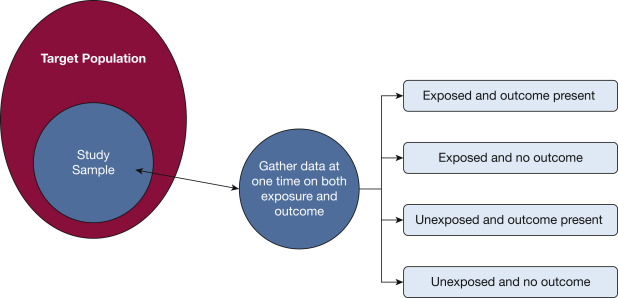
Cross-sectional research: a snapshot of a population
Cross-sectional research is a type of observational study that examines information from a population at a particular point in time, or over a short, defined period. Researchers use it to describe the characteristics of a group and explore how different factors are related.
It is often compared to a snapshot: it can show what is happening within a population at the time of data collection, but it does not usually show how individuals or conditions change over time.
How does a cross-sectional study work?
Researchers first define the population they want to study and decide how to select participants. They then collect information, often through surveys, interviews, examinations, or existing records. The information may cover outcomes, such as a health condition, as well as possible related factors, such as age, occupation, behaviour or living conditions.
For example, a study might survey adults in a town to estimate how many currently experience sleep problems and examine whether sleep problems are associated with factors such as working patterns or housing conditions.
Because information about the possible factors and outcomes is generally collected at the same time, cross-sectional studies can identify patterns and associations. However, they often cannot establish which came first.
What is cross-sectional research used for?
- Estimating prevalence: measuring how common a condition, behaviour or characteristic is in a population at a given time.
- Describing a population: summarising characteristics such as age, employment, health status or access to services.
- Exploring associations: investigating whether two or more factors tend to occur together.
- Informing further research: identifying questions that may warrant a longitudinal study, experiment or more detailed investigation.
Common types of cross-sectional study
A descriptive cross-sectional study aims to describe the frequency or distribution of characteristics in a population. For instance, it might measure the proportion of residents who use a particular service.
An analytical cross-sectional study examines relationships between factors. It might compare the prevalence of a health outcome among groups with different levels of exposure to a particular condition or behaviour.
Advantages
- Relatively quick: data are usually collected once rather than repeatedly over an extended period.
- Can be cost-effective: the design may require fewer resources than studies that follow participants over time.
- Useful for planning: prevalence estimates can help organisations understand the scale of an issue and plan services or further research.
- Can examine several factors: a single study may collect information on multiple outcomes and potential associated factors.
- Can study real-world populations: researchers can investigate patterns in community, workplace or service settings.
Limitations
The main limitation is that a cross-sectional study usually cannot establish the direction of a relationship. If two factors are associated, it may be unclear whether one influenced the other, whether the relationship works in the opposite direction, or whether another factor helps explain the pattern. This is known as the problem of temporal ambiguity.
For the same reason, cross-sectional findings alone generally cannot demonstrate that one factor caused another. An observed association may be influenced by confounding variables, measurement errors or the way participants were selected.
Other limitations may include:
- Selection bias: the people who take part may differ from those who do not.
- Non-response: if certain groups are less likely to participate, the results may not represent the intended population.
- Recall or reporting bias: participants may not remember information accurately or may answer questions in ways they consider socially acceptable.
- Limited insight into change: a single data collection period cannot show how outcomes develop over time.
- Survivorship effects: studies of existing cases may miss people whose condition was brief, resolved or otherwise not present when the data were collected.
How researchers can strengthen a study
Careful planning can improve the quality and usefulness of cross-sectional research. Researchers should define the target population clearly, use an appropriate sampling method and explain how participants were recruited. They should use reliable measures, report how missing data were handled and consider potential confounding factors when analysing results.
Results should be described in terms that match the study design. It is usually more accurate to say that two factors were associated than to say that one factor caused the other. Researchers should also report who took part and acknowledge limitations that could affect how broadly the findings apply.
For observational studies, reporting guidance such as the STROBE statement can help researchers describe their methods and findings transparently. Reporting guidance supports clear communication; it does not, by itself, guarantee that a study is free from bias.
Cross-sectional research compared with other designs
Unlike a longitudinal study, which collects information from the same participants at multiple time points, a cross-sectional study generally collects information once. Longitudinal research can help show how circumstances change and clarify which events happened first, but it may take longer and require more resources.
Unlike an experimental study, a cross-sectional study does not assign participants to an intervention. It observes characteristics as they occur, making it useful for describing real-world patterns but more limited for drawing conclusions about cause and effect.
In summary
Cross-sectional research provides a useful snapshot of a population. It can estimate how common a condition or characteristic is and reveal associations that may guide policy, practice or future studies. Its findings need to be interpreted with care, particularly when considering causation, because the design usually cannot establish the timing or direction of a relationship.
Understanding Cross-Sectional Research: Key Questions and Insights
- What is cross-sectional research?
- What is the main purpose of a cross-sectional study?
- What are the advantages and disadvantages of cross-sectional research?
- Can a cross-sectional study establish cause and effect?
- How is cross-sectional research different from longitudinal research?
- When should researchers use a cross-sectional study?
What is cross-sectional research?
Cross-sectional research is an observational study that collects information about a population at a specific point in time, providing a snapshot of its characteristics, experiences or health. Researchers can use it to estimate how common something is and explore associations between different factors. However, because information is usually gathered at one time, the study cannot typically show how things change or establish that one factor caused another.
What is the main purpose of a cross-sectional study?
The main purpose of a cross-sectional study is to provide a snapshot of a population at a particular point in time. Researchers use it to describe how common a condition or characteristic is and to explore associations between different factors. Because information is usually collected once, the study can reveal patterns but generally cannot show how they change over time or prove that one factor causes another.
What are the advantages and disadvantages of cross-sectional research?
Cross-sectional research offers a relatively quick and cost-effective way to describe a population, estimate how common a condition or characteristic is, and explore associations between several factors at a single point in time. It can help identify patterns and guide service planning or further research. However, because information is usually collected only once, it cannot show how things change over time or reliably establish which factor came first. As a result, associations should not be treated as proof of cause and effect, and findings may also be affected by sampling bias, non-response or inaccurate reporting.
Can a cross-sectional study establish cause and effect?
No. A cross-sectional study measures potential causes and outcomes at roughly the same time, so it usually cannot establish which came first or show that one factor caused another. It can identify associations, but these may be explained by reverse causation, other influencing factors or bias. Establishing cause and effect generally requires stronger evidence, often from research that follows people over time or tests an intervention.
How is cross-sectional research different from longitudinal research?
Cross-sectional research collects information from a population at one point in time, providing a snapshot of its characteristics or experiences. Longitudinal research, by contrast, gathers information from the same participants repeatedly over a longer period, allowing researchers to track changes and explore how factors develop or relate over time. Cross-sectional studies are often quicker to carry out, but they cannot usually show which event came first; longitudinal studies can offer greater insight into change and timing, though they typically require more time and resources.
When should researchers use a cross-sectional study?
Researchers should use a cross-sectional study when they want to describe a population or measure how common a condition, behaviour or characteristic is at a particular point in time. It can also be useful for exploring associations between factors and identifying questions for further research. This design is often practical when time or resources are limited, but it is less suitable when the aim is to track changes over time or establish cause and effect, as information is generally collected only once.