
Action Research Methodology: A Practical Guide to Planning, Practice and Reflection
Action Research Methodology: A Practical Guide
Action research is an approach to inquiry that combines systematic investigation with practical action. Rather than studying a situation from a distance, researchers work with the people involved to understand a problem, try out potential improvements and learn from the results. The aim is both to develop knowledge and to bring about meaningful change.
Action research is used in fields such as education, health, social care, community development and organisational management. It can be particularly valuable when a challenge is rooted in everyday practice and those affected by it have important knowledge to contribute.
What is action research?
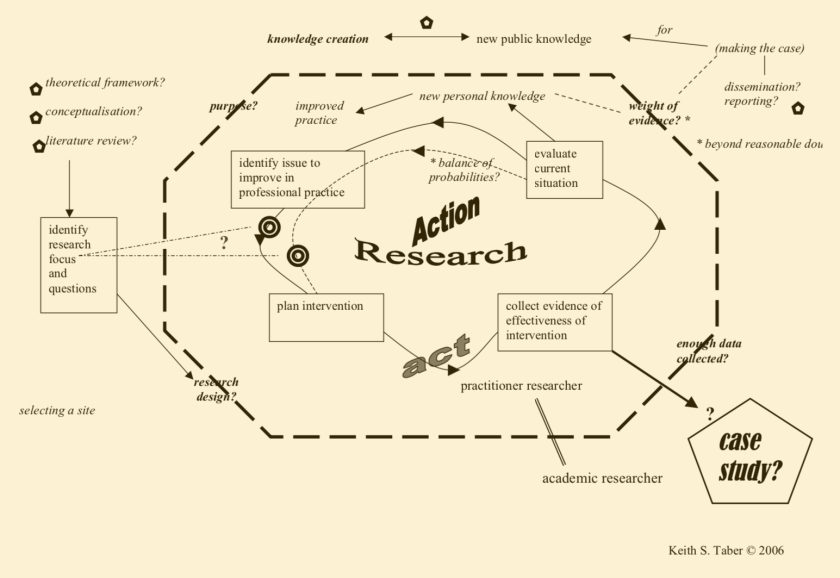
Action research is usually collaborative and cyclical. Researchers and participants identify an issue, plan an intervention, put it into practice, examine what happens and use that learning to decide what to do next. This process may be repeated several times, allowing the work to adapt as new insights emerge.
Unlike research that aims only to describe or explain a situation, action research explicitly connects understanding with action. However, taking action is not enough on its own: the process should be carefully documented and critically examined so that conclusions are grounded in evidence.
The action research cycle
There is no single model used by every action researcher, but the methodology commonly includes the following stages:
- Identify the issue: Define a practical concern or opportunity for improvement. This may involve reviewing existing evidence, discussing experiences with participants and clarifying whose perspectives need to be included.
- Plan: Agree on a change or intervention to explore. Set out the questions the research will address, how information will be gathered and what outcomes might indicate progress.
- Act: Put the planned change into practice. The intervention could be a new teaching activity, a revised service process, a community initiative or another practical response to the issue.
- Observe: Gather information about what happens. Researchers might use interviews, observations, surveys, records, group discussions or reflective journals.
- Reflect: Review the evidence with participants. Consider what worked, what did not, why outcomes may have occurred and what unintended effects appeared.
- Revise and repeat: Use the learning to refine the approach and begin another cycle, if appropriate.
The cycle is often shown as a sequence, but in practice the stages can overlap. For example, new information may emerge during an intervention and lead the group to adjust the plan straight away.
Key principles
Participation and collaboration
Action research treats participants as contributors to the inquiry, rather than simply as subjects being studied. Their knowledge can shape the research questions, the intervention and the interpretation of findings. The level of participation varies: some projects are led by practitioners, while others are jointly designed and governed by community members, researchers or service users.
Reflection
Reflection is central to the methodology. Researchers and participants examine their assumptions, decisions and actions, as well as the evidence collected. Keeping a reflective journal or holding regular review meetings can help make this process visible and encourage learning throughout the project.
Context and practical relevance
Action research is usually concerned with a specific setting, such as a school, workplace or community. Findings are therefore closely connected to local circumstances. Rather than assuming that one solution will work everywhere, the research explores what is useful in a particular context and why.
Cycles of learning
The iterative nature of action research makes it possible to respond to changing circumstances. Each cycle can refine the intervention and improve understanding of the problem. This flexibility is a strength, although changes to the plan should be recorded and explained.
Methods and sources of evidence
Action research can use qualitative, quantitative or mixed methods. The choice depends on the research questions and on what information will help participants assess the change.
- Qualitative methods, such as interviews, focus groups, observations and open-ended questionnaires, can reveal experiences, perceptions and processes.
- Quantitative methods, such as structured surveys, attendance figures or service data, can help track patterns and changes over time.
- Documentary evidence, including meeting notes, policy documents and work samples, can show how practice or decision-making develops.
- Reflective records, such as journals and field notes, can capture researchers’ observations and the reasoning behind decisions.
Using several sources of evidence can provide a fuller picture than relying on a single measure. For example, a change in test results may be considered alongside learner feedback and classroom observations.
Planning a robust project
A clear plan helps keep action research purposeful while leaving room to adapt. Before beginning, it is useful to:
- define the problem in practical, focused terms;
- involve the people affected by the issue in shaping the research;
- identify relevant research and existing evidence;
- agree on realistic questions and outcomes;
- select methods that are suitable for the setting and participants;
- decide how information will be analysed and shared;
- allow sufficient time for reflection and more than one cycle, where possible.
Researchers should also distinguish between evidence of improvement and evidence that an intervention caused the improvement. Other changes in the setting may have influenced the results. Careful records and balanced interpretation help avoid making claims that go beyond the available evidence.
Ethics in action research
Because action research takes place in real settings and often involves ongoing relationships, ethical considerations need attention throughout the project. Participants should understand the purpose of the research, what taking part involves and how information will be used. Consent should be informed and voluntary, and people should be able to raise concerns or withdraw where appropriate.
Confidentiality, privacy and secure handling of information are also important. Researchers should consider power differences, particularly where they hold professional authority over participants. Participation should not become compulsory simply because the research is taking place within a workplace, school or service. Involving participants in decisions can support ethical practice, but it does not remove the researcher’s responsibility to protect their rights and welfare.
Strengths and challenges
Action research can help practitioners address problems that matter in their own settings. It encourages collaboration, supports learning through practice and can produce changes that are more responsive to local needs. The process may also strengthen participants’ ability to investigate and improve their own work.
There are challenges, too. Projects can be time-consuming, and it may be difficult to balance the roles of practitioner, researcher and colleague. Participants may have differing priorities, while organisational pressures can make it hard to sustain the work. Because findings are often context-specific, they may not be directly transferable to other settings. Transparency about the setting, methods and limitations helps readers judge how relevant the findings may be elsewhere.
Example: improving participation in lessons
A teaching team notices that a small group of pupils rarely contributes to class discussions. The team reviews relevant research and speaks with pupils about their experiences. Together, they decide to trial short paired discussions before whole-class questions.
Over several weeks, teachers record participation patterns, observe lessons and invite pupils to share feedback. At a review meeting, the team finds that more pupils are contributing, but some still feel uncomfortable speaking in front of the class. The next cycle introduces written responses as an additional option. The project combines a practical change with evidence and reflection, and adjusts the approach in response to participants’ experiences.
Conclusion
Action research methodology offers a structured way to investigate practical concerns while working towards improvement. Its defining features are cycles of planning, action, observation and reflection, alongside collaboration with people who understand the setting. When conducted ethically and documented carefully, it can generate useful local knowledge and support thoughtful, evidence-informed change.
Six Practical Tips for Effective Action Research
- Start with a clear, practical research question.
- Involve participants in planning and decision-making.
- Use small cycles of planning, action, observation and reflection.
- Collect evidence systematically from more than one source.
- Keep a reflexive record of decisions and assumptions.
- Use findings to adapt practice and plan the next cycle.
Start with a clear, practical research question.
Begin with a clear, practical research question that focuses on an issue you can investigate and influence in your setting. A well-defined question helps guide the action you take, the evidence you collect and how you assess the results. Keep it specific and grounded in real practice—for example, ask whether introducing a weekly peer-feedback session improves participation, rather than trying to address a broad question such as how to improve learning.
Involve participants in planning and decision-making.
Involve participants in planning and decision-making from the outset. Their first-hand knowledge can help shape relevant research questions, realistic actions and appropriate ways to assess progress. Shared decision-making also builds trust and a sense of ownership, making participants more likely to engage with the process and sustain any changes. Be clear about how decisions will be made, and ensure that all voices—not only the most confident or influential—are heard.
Use small cycles of planning, action, observation and reflection.
Use small cycles of planning, action, observation and reflection to make action research manageable and responsive. Start with a focused change, try it in practice, gather feedback or other relevant evidence, and reflect on what happened. Use these insights to adjust your approach before the next cycle. Small steps make it easier to spot what is working, address challenges early and learn as you go.
Collect evidence systematically from more than one source.
Collect evidence systematically from more than one source to build a fuller, more reliable picture of what is happening. For example, combine observations with interviews, questionnaires, reflective notes or existing records, and gather information at consistent points throughout each action research cycle. Comparing these sources can reveal patterns, highlight differing perspectives and help distinguish genuine changes from individual impressions. Keep clear records of how evidence was collected and be mindful of participants’ privacy and consent.
Keep a reflexive record of decisions and assumptions.
Keep a reflexive record of the decisions you make and the assumptions behind them throughout your action research. Brief notes in a journal can capture why you chose a particular intervention, how your role or expectations may shape what you notice, and what prompted you to change direction. Reviewing these records during each cycle helps make the research process transparent, highlights possible bias and supports more thoughtful interpretation of the findings.
Use findings to adapt practice and plan the next cycle.
Use the findings from each cycle to refine your practice and decide what to investigate next. Reflect with participants on what changed, what worked well, what barriers arose and whether there were any unexpected effects. Use this learning to adjust the intervention, gather further evidence where needed and set a clear focus for the next cycle. This makes action research responsive to real-world experience and supports ongoing, evidence-informed improvement.