
Narrative Inquiry: Understanding Experience Through Stories
Narrative Inquiry: Understanding Experience Through Stories
Narrative inquiry is a qualitative research approach that explores how people make sense of their experiences through stories. Rather than treating events as isolated facts, it examines how people describe what happened, how they interpret it and how their accounts change over time and in different settings.
Stories are a familiar way of communicating: people use them to explain decisions, remember turning points and share ideas about who they are. For researchers, these accounts can offer insight into experiences that may be difficult to capture through surveys or numerical data alone. Narrative inquiry is used across fields including education, health, psychology, social work and organisational studies.
What makes an approach narrative?
At the heart of narrative inquiry is the idea that experience is understood in context. Researchers pay attention not only to what a participant says happened, but also to when and where the events took place, who was involved and how the account is shaped by relationships, culture and memory.
One influential framework describes narrative inquiry through three connected dimensions:
- Temporality: experiences unfold over time. Researchers may consider what came before an event, what happened during it and how it is understood afterwards.
- Sociality: stories are shaped by personal feelings and beliefs, as well as by relationships, communities and wider social expectations.
- Place: experiences happen in particular settings, such as a classroom, clinic, workplace or home, and those settings can influence what takes place.
These dimensions help researchers look beyond a sequence of events and consider the conditions that give those events meaning.
How is narrative inquiry conducted?
A narrative inquiry often begins with a broad research question about experience. For example, a researcher might ask how people experience a change in their working lives, how patients understand recovery or how teachers make sense of their professional development.
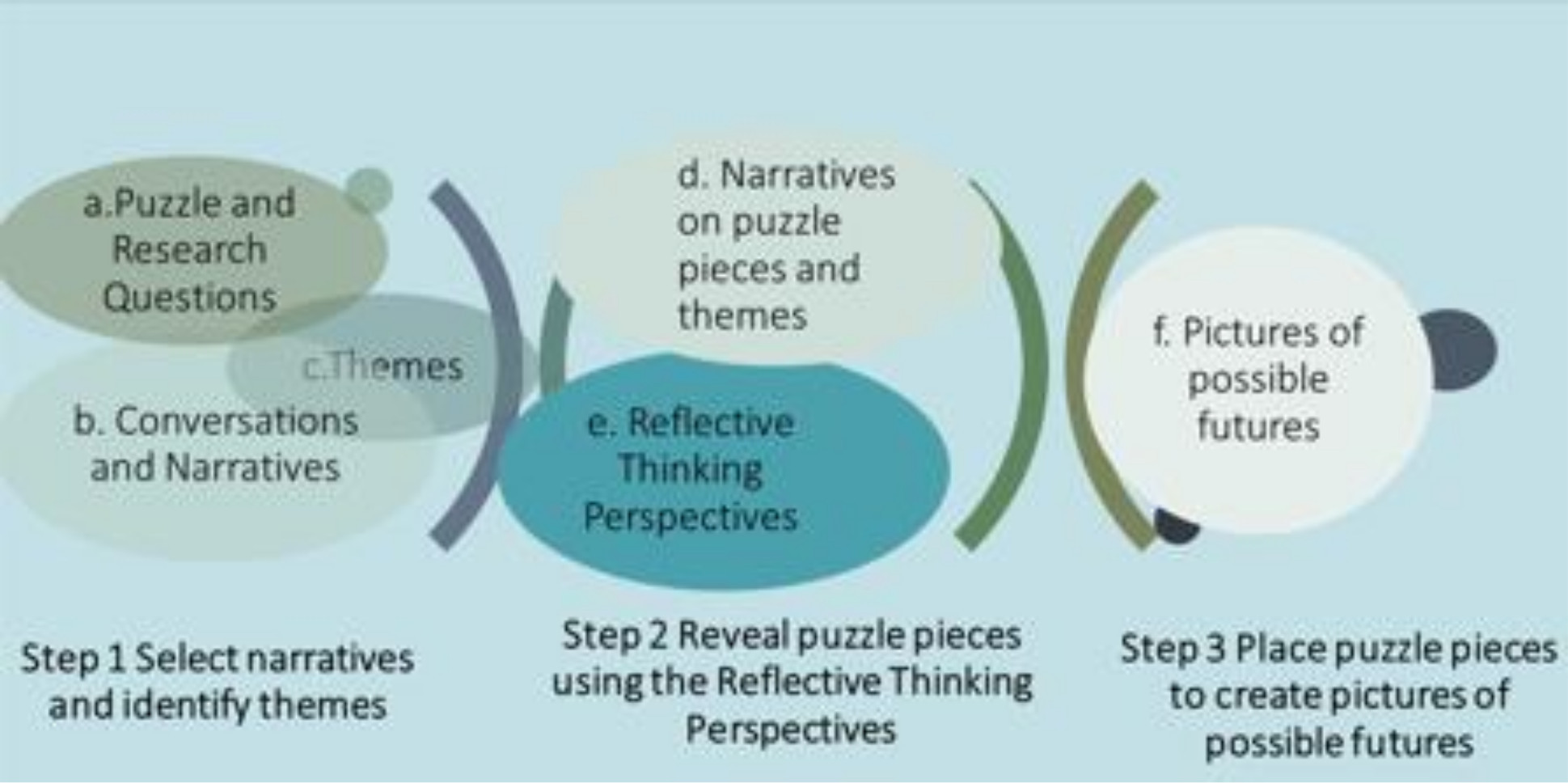
Researchers may gather material through interviews, conversations, diaries, letters, photographs, recordings or observations. Participants might be invited to tell their stories in their own words, while the researcher asks open questions to explore particular moments or changes. The process is usually flexible: new themes or questions can emerge as the study develops.
Analysis involves more than summarising what participants have said. Researchers may consider the structure of a story, its key events, recurring themes, turning points and the language used to describe people or experiences. They may also examine how an account changes when told to different audiences or at different points in time. Some studies present participants’ accounts as individual narratives; others compare stories to identify shared patterns and differences.
The role of the researcher
Narrative inquiry recognises that research is a relationship between people. The researcher is not simply a neutral recorder: their questions, assumptions and presence can influence what is shared and how it is interpreted. Their own background and perspective also affect the analysis.
For this reason, researchers often reflect on their role throughout a study. They may explain how they developed their interpretations, distinguish participants’ words from their own commentary and invite participants to discuss or respond to draft accounts. This does not mean that every participant must agree with every interpretation, but it can make the research process more transparent.
Ethical considerations
Personal stories can include sensitive details about health, family, identity or difficult events. Protecting participants involves more than replacing names with pseudonyms. A combination of details may still make someone identifiable, particularly in a small community or workplace.
Researchers should explain how stories may be used, stored and shared, and give participants meaningful choices about what they are willing to disclose. They should also consider how editing a story might change its meaning, and whether publication could affect the people described in it. Consent is best treated as an ongoing conversation rather than a one-off form.
Strengths and limitations
Narrative inquiry can reveal complexity, change and personal meaning. It gives space to perspectives that may be overlooked in broad statistical summaries and can help show how institutions and social conditions are experienced in everyday life. It is particularly useful when the research question concerns identity, memory, transition or the meaning people attach to events.
However, stories are not straightforward records of the past. They are shaped by memory, audience, language and the circumstances in which they are told. A narrative study also tends to involve a limited number of participants, so its findings are not usually intended to represent a whole population statistically. Instead, researchers aim to provide a careful, contextual account that readers can assess in relation to other settings.
In summary
Narrative inquiry offers a way to study human experience through the stories people tell. By attending to time, relationships and place, it helps researchers understand not only what happened, but how events are interpreted and given meaning. When carried out thoughtfully and ethically, it can produce rich, nuanced insight into the ways people live, remember and make sense of their worlds.
Exploring Depth and Context: The Benefits of Narrative Inquiry in Understanding Personal and Social Experiences
- Provides rich insight into personal experiences.
- Captures change and meaning over time.
- Gives participants a voice in their own words.
- Reveals social and cultural context.
- Offers nuanced perspectives on complex issues.
Challenges of Narrative Inquiry: Limitations in Generalisability, Memory Bias, Subjectivity, and Ethical Concerns
- Findings may not be generalisable.
- Stories can be shaped by memory and bias.
- Analysis can be subjective and time-consuming.
- Sensitive accounts raise ethical and privacy concerns.
Provides rich insight into personal experiences.
Narrative inquiry provides rich insight into personal experiences by giving people space to describe events in their own words and explain what those events mean to them. Rather than reducing experience to brief answers or numerical measures, it can reveal emotions, relationships, turning points and the wider circumstances that shape a person’s story. This depth helps researchers understand not only what happened, but how individuals interpret and make sense of their experiences.
Captures change and meaning over time.
A key strength of narrative inquiry is its ability to capture how experiences and their meanings develop over time. By exploring people’s accounts of what happened before, during and after significant events, researchers can trace changes in perspective, identity and understanding. This provides a richer picture than a single snapshot, showing how individuals make sense of their experiences as their circumstances evolve.
Gives participants a voice in their own words.
Narrative inquiry gives participants the opportunity to describe their experiences in their own words, rather than having their views reduced to predefined categories or interpreted solely through someone else’s perspective. By sharing personal stories, participants can decide which events matter, how they understand them and what meanings they wish to convey. This can bring forward perspectives that might otherwise be overlooked and help researchers represent people’s experiences with greater depth and authenticity.
Reveals social and cultural context.
Narrative inquiry reveals the social and cultural context surrounding people’s experiences. By exploring the stories individuals tell, researchers can see how relationships, community expectations, cultural values and wider social conditions shape events and the meanings people give them. This helps place personal experiences within the environments in which they occur, offering a richer understanding than accounts that focus on individual actions alone.
Offers nuanced perspectives on complex issues.
Narrative inquiry offers nuanced perspectives on complex issues by exploring how people experience and interpret events within the contexts of their lives. Rather than reducing experiences to simple categories or numerical measures, it can reveal differing viewpoints, changing emotions and the influence of relationships, culture and circumstances. This helps researchers understand not only what happens, but why it matters to the people involved.
Findings may not be generalisable.
A limitation of narrative inquiry is that its findings may not be generalisable to wider populations. Studies often focus on a small number of participants and explore their experiences in depth, so the results reflect particular people, places and circumstances rather than a representative sample. The findings can still offer valuable insight and help readers understand similar situations, but they should be applied to other contexts with care.
Stories can be shaped by memory and bias.
A limitation of narrative inquiry is that stories can be shaped by memory and bias. People may forget details, interpret past events differently over time or emphasise certain moments to fit how they understand themselves today. Their accounts can also be influenced by the audience, the questions asked and what they feel comfortable sharing. Researchers therefore need to interpret stories carefully, recognising that they offer a personal perspective rather than an entirely objective record of events.
Analysis can be subjective and time-consuming.
A potential drawback of narrative inquiry is that analysing stories can be both subjective and time-consuming. Researchers must interpret participants’ words, context and meaning, and their own assumptions may influence how they identify themes or present events. Analysing detailed accounts carefully—and checking interpretations where appropriate—takes considerable time, which can make narrative studies demanding to conduct.
Sensitive accounts raise ethical and privacy concerns.
Narrative inquiry can involve deeply personal accounts of trauma, illness, family life or other sensitive experiences, creating ethical and privacy concerns for both participants and researchers. Even when names are removed, distinctive details may make someone identifiable, particularly in a small community. Researchers must therefore obtain informed, ongoing consent, store material securely and consider carefully how stories are edited, quoted and shared. They also need to minimise the risk of distress or harm, while respecting participants’ control over how their experiences are represented.