
Business Innovation: Turning Ideas into Lasting Value
Business Innovation: Turning New Ideas into Lasting Value
Business innovation is often associated with breakthrough technology or an entirely new product. But it can also be a small improvement to a service, a more efficient process, a different way of working with customers or a fresh approach to solving a familiar problem. At its heart, innovation is about putting useful ideas into practice and creating value.
What does business innovation mean?
Innovation is more than having ideas. It involves identifying an opportunity, developing a response and learning whether that response works. The result might be a product or service, but it could equally be a change to a business model, supply chain, workplace practice or customer experience.
For example, a business might introduce a digital booking system to make appointments easier, redesign packaging to reduce waste, or offer a subscription option that gives customers greater flexibility. The scale of the change matters less than whether it addresses a real need and can be delivered effectively.
Why innovation matters
Customer expectations, technology and market conditions continue to change. Businesses that pay attention to these shifts are better placed to adapt. Innovation can help an organisation improve its products, work more efficiently, reach new customers and respond to emerging challenges.
It can also support resilience. Reviewing how a business operates can reveal dependencies, unnecessary costs or processes that no longer serve customers well. By testing improvements before they become urgent, organisations can build the ability to respond when circumstances change.
Innovation is not a guarantee of success, however. New ideas can require investment and may not deliver the intended results. A thoughtful approach balances ambition with evidence, manageable risks and a clear understanding of the people the change is meant to help.
Creating the conditions for innovation
Innovation is more likely to flourish when people have the time and confidence to question existing approaches. Leaders can encourage this by listening to staff and customers, welcoming constructive challenge and treating well-designed experiments as opportunities to learn.
A supportive culture does not mean pursuing every idea. It means giving promising ideas a fair assessment. Teams need clear priorities, access to relevant information and a practical route for suggesting, testing and improving changes. Recognition should also be given to useful improvements, not only dramatic successes.
Start with a real problem
Successful innovation usually begins with a problem worth solving. Businesses can look for recurring customer frustrations, delays in internal processes, avoidable waste or gaps in the services available to a particular group. Speaking directly with customers and employees can reveal issues that are easy to miss from a distance.
Defining the problem clearly helps prevent teams from becoming attached to a solution before they understand what is needed. A useful question is: “What would make this experience better, and for whom?” The answer can provide a stronger starting point than simply asking which new technology to adopt.
Test, learn and improve
Rather than making a large commitment at the outset, a business can test an idea on a limited scale. A pilot, prototype or trial can show how people respond and identify practical obstacles. The organisation can then refine the idea, expand it or decide not to proceed.
Each test should have a clear purpose. Businesses might measure customer satisfaction, time saved, costs, reliability or environmental impact, depending on the goal. Results should be reviewed honestly: a test that disproves an assumption can still provide valuable insight and prevent a more costly mistake.
Technology is a tool, not a strategy
Digital tools, automation and data analysis can enable new ways of working, but technology alone does not make a business innovative. The important questions are what need the technology addresses, whether it is suitable for the people who will use it and how it fits with the organisation’s wider goals.
Businesses should also consider issues such as data protection, accessibility, security and staff training. A tool that is difficult to use or poorly integrated may create extra work rather than improve performance. Careful planning helps ensure that technology supports a meaningful change.
Make innovation part of everyday work
Innovation need not sit in a separate department. People across an organisation often have direct knowledge of customers, suppliers and day-to-day operations. Giving them a clear way to share ideas can help businesses spot opportunities earlier and develop solutions grounded in practical experience.
Partnerships can also broaden a business’s perspective. Working with customers, suppliers, universities, industry groups or other organisations may provide expertise and insight that would be difficult to develop alone. Strong collaboration depends on clear aims, open communication and agreement about responsibilities.
Conclusion
Business innovation is a disciplined way of responding to change and creating better outcomes. It starts with understanding people’s needs, continues through careful testing and depends on a willingness to learn. By making space for useful ideas and focusing on measurable value, businesses can improve how they serve customers and build a stronger foundation for the future.
Exploring Business Innovation: Key Questions and Insights
- What is business innovation?
- Why is business innovation important?
- What are the main types of business innovation?
- How can a business develop a culture of innovation?
- How can small businesses innovate with limited resources?
- How can businesses measure the success of innovation?
What is business innovation?
Business innovation is the process of developing and putting new or improved ideas into practice to create value. It can involve introducing a product or service, improving how work is done, adopting new technology or changing a business model. Effective innovation responds to a real need, whether that means making things easier for customers, improving efficiency or helping a business adapt to change.
Why is business innovation important?
Business innovation is important because it helps organisations respond to changing customer needs, new technologies and evolving market conditions. By improving products, services and ways of working, businesses can operate more efficiently, find new opportunities and remain competitive. Innovation can also strengthen resilience, helping organisations adapt to challenges and create lasting value for customers, employees and the wider community.
What are the main types of business innovation?
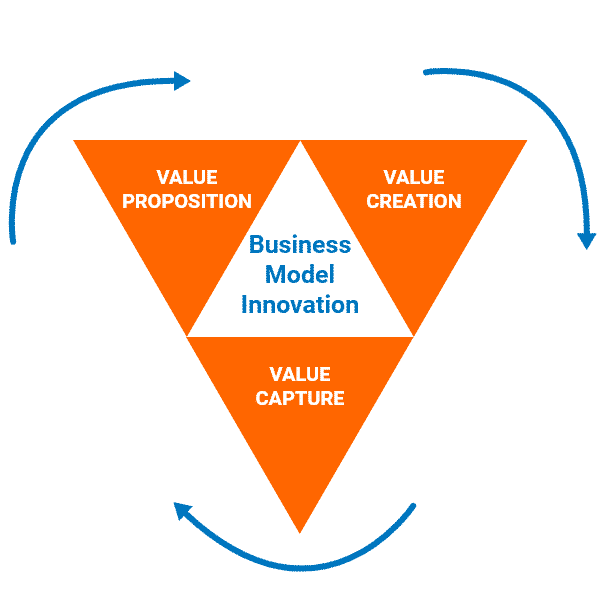
The main types of business innovation include product innovation, which introduces or improves goods and services; process innovation, which changes how they are created or delivered; business model innovation, which rethinks how a company creates and earns value; and marketing innovation, which changes how products are presented, priced or promoted. Organisational innovation—new ways of structuring teams, managing work or collaborating—can also help businesses adapt and perform more effectively. These types often overlap, and innovation may involve a small improvement as well as a major change.
How can a business develop a culture of innovation?
A business can develop a culture of innovation by making it safe and worthwhile for people to share ideas, question established ways of working and learn from experiments. Leaders should set clear goals, listen to staff and customers, and give teams time and support to test promising improvements on a manageable scale. Recognising thoughtful effort, including lessons from ideas that do not succeed, helps build confidence and encourages continuous improvement. Innovation is strongest when it is part of everyone’s work, rather than the responsibility of a single team.
How can small businesses innovate with limited resources?
Small businesses can innovate by focusing on practical, low-cost improvements rather than large-scale change. Start by asking customers and staff what could work better, then choose one clearly defined problem to tackle. Test a simple solution on a small scale, using existing tools and skills where possible, and measure whether it saves time, reduces costs or improves the customer experience. Collaborating with other local businesses, sharing expertise and making use of free or affordable digital resources can also help. The key is to experiment, learn from what does not work and build on successful changes.
How can businesses measure the success of innovation?
Businesses can measure the success of innovation by setting clear objectives and choosing relevant indicators before a new idea is introduced. These might include revenue growth, cost savings, customer satisfaction, adoption rates, time saved, product quality or reduced environmental impact. It is also useful to track progress over time and gather feedback from customers and staff, as early results may differ from long-term outcomes. Not every experiment will succeed commercially, but learning gained, risks avoided and improvements made can also show whether the innovation process is delivering value.